

Ford Transit High Roof Height: Interior Dimensions and Upfit Guide
The short answer: a High Roof Ford Transit gives you 81.5 inches of interior cargo height and stands 110.1 inches tall on the outside. Those are two different numbers and mixing them up is the most expensive mistake in a van order.
In This Guide
- All Three Transit Roof Heights, Inside and Out
- Interior Height and Exterior Height Are Not the Same Number
- Floor Length, Width, and the Plywood Test
- Door Openings: What Actually Limits What You Load
- Picking a Roof Height for Your Upfit
- Clearance Notes for Clarksville and Fort Campbell Fleets
- Frequently Asked Questions
All Three Transit Roof Heights, Inside and Out
The Ford Transit comes in Low, Medium, and High Roof. Each one changes two measurements at once: how much room a technician has inside, and how much overhead clearance the van needs to get where it is going. Here is the full set in one place.
| Roof | Interior Cargo Height | Exterior Overall Height | Rear Door Opening Height | Side Door Opening |
|---|---|---|---|---|
| Low Roof | 56.9 in | 83.2 in | 49.5 in | 49.6 x 51.2 in |
| Medium Roof | 72.0 in | 100.8 in | 64.9 in | 63.0 x 51.2 in |
| High Roof | 81.5 in | 110.1 in | 74.3 in | 63.0 x 51.2 in |
Transit roof heights, drawn to scale
Interior Height and Exterior Height Are Not the Same Number
This is where van orders go wrong. The two heights get quoted interchangeably, and they are almost 30 inches apart on a High Roof.
Interior cargo height is measured from the cargo floor to the ceiling. It decides whether your technician stands up, whether a shelving unit fits, and how much cubic volume you get. Exterior overall height is measured from the ground to the highest point of the roof. It decides whether the van gets into your shop, under a parking deck beam, or through a drive-thru.
A High Roof Transit needs 110.1 inches of clearance, which is 9 feet 2 inches. That is taller than a standard residential garage door, taller than most older shop bays, and taller than the posted clearance on a lot of covered parking. Before you sign the order, measure the doorway the van will actually use every day, then add whatever ends up on the roof: a rack, a vent fan, a ladder rack, an antenna.
Floor Length, Width, and the Plywood Test
Roof height gets the attention, but floor dimensions decide what you can actually carry flat. The Transit is offered on a 130-inch wheelbase and a 148-inch wheelbase, and the 148-inch is offered in a standard and an Extended Length body.
- Cargo floor length: roughly 126 inches on the shortest configuration up to 172.2 inches on the Extended Length, which is 10 feet 6 inches to 14 feet 4 inches.
- Width between the rear wheel wells: 54.8 inches on every Transit, regardless of roof.
- Cargo volume: 246.7 cubic feet on a Low Roof regular wheelbase, up to 487.3 cubic feet on a High Roof Extended Length, measured behind the first row.
- Maximum payload: up to 5,103 lbs on a properly equipped Transit 350 HD dual rear wheel Extended Length High Roof with the 3.5L EcoBoost V6 at the 11,000 lb GVWR rating.
The plywood test, seen from the rear
Payload is the figure that surprises people after an upfit. Shelving, a partition, a ladder rack, and a full parts inventory can take a four-figure bite out of what is left for cargo. Have the upfit weight subtracted before you commit to a GVWR class, not after the van is built. Our commercial team can run that math with you on a real build sheet.
Back to topDoor Openings: What Actually Limits What You Load
Interior height tells you what fits once it is inside. Door opening height tells you what gets in at all, and it is always the smaller number.
The rear cargo doors open 74.3 inches tall on a High Roof, 64.9 inches on a Medium Roof, and 49.5 inches on a Low Roof. The side sliding door is 63.0 inches tall by 51.2 inches wide on the Medium and High Roof, and 49.6 by 51.2 inches on the Low Roof.
If you roll equipment in on a cart, the rear door opening is your real constraint. A High Roof gives 81.5 inches of ceiling but only 74.3 inches of doorway, so anything between those two numbers has to be tipped, lifted, or loaded through a different opening. Measure your tallest regular load before you pick a roof.
Back to topPicking a Roof Height for Your Upfit
The roof you order locks in what upfit packages will fit, so this decision comes before the shelving quote, not after.
High Roof, 81.5 inches
The right call whenever a technician works inside the van. Plumbers, electricians, HVAC techs, and mobile service operations all gain real time from standing at a bench instead of working bent over. It is also the only roof that supports full-height shelving with a work surface underneath. The cost is 110.1 inches of exterior clearance you have to plan around every day.
Medium Roof, 72.0 inches
A good middle for vans loaded and unloaded from outside rather than worked in. You still get a 64.9-inch rear door and the same 63.0-inch side door as the High Roof, so loading is barely compromised. At 100.8 inches overall it clears more structures than a High Roof, though still not a residential garage.
Low Roof, 56.9 inches
Choose this when a height restriction makes the decision for you: a parking deck, an older shop bay, a downtown loading dock. At 83.2 inches it is the only Transit that comes close to a standard garage door. Accept that nobody is working inside it.
Clearance Notes for Clarksville and Fort Campbell Fleets
A 110.1-inch van changes daily routing more than most buyers expect. A few things worth checking before you commit a High Roof to a Clarksville-area route.
- Your own shop bay. Older commercial bays along the US-41A corridor were built for pickups and box trucks, not 9-foot-2 vans. Measure the actual opening, not the drawing.
- Covered parking and decks. Posted clearance on structured parking is commonly under 8 feet. A High Roof does not fit and a Medium Roof usually does not either.
- Base access at Fort Campbell. If your crews run work onto the installation, confirm height limits on the specific gates and facilities your contract covers rather than assuming a single number applies everywhere.
- Drive-thru anything. Assume no. Plan fuel stops and lunch around a van that does not fit under a canopy.
None of this argues against a High Roof. It argues for measuring first. Most trades operations that switch to a High Roof would not go back, because the time saved standing up inside the van outweighs a slightly longer route. Just make that trade knowingly.
We are at 2655 Trenton Road in Clarksville, minutes from I-24 and about 20 minutes from Fort Campbell, and we are Tennessee's first Ford Pro Elite Commercial Service Center with dedicated commercial lanes and extended hours. If you are financing a fleet purchase, our commercial financing team handles business applications directly, and Section 179 may apply to a qualifying work van placed in service this year. Ask your tax advisor about your own situation.
Back to topFrequently Asked Questions
How tall is the inside of a Ford Transit high roof?
The High Roof Ford Transit has 81.5 inches of maximum interior cargo height, which is 6 feet 9.5 inches. Most adults up to roughly 6 feet 5 inches stand fully upright inside without stooping. The Medium Roof gives 72.0 inches and the Low Roof gives 56.9 inches, which is a kneeling or crouching height rather than a standing one.
What is the exterior height of a Ford Transit high roof van?
A High Roof Transit stands 110.1 inches tall overall, or about 9 feet 2 inches. Medium Roof is 100.8 inches and Low Roof is 83.2 inches. Exterior height is the number that decides whether the van clears your shop door, a parking deck, or a drive-thru. Interior height is a separate measurement and the two are often confused.
Will a Ford Transit high roof fit in a standard garage?
No. A standard residential garage door is 84 inches tall and a High Roof Transit needs 110.1 inches, so it will not clear. Only the Low Roof at 83.2 inches comes close, and that leaves under an inch of margin before you add a roof rack or a vent fan. Measure your actual door opening, not the nominal size, and add clearance for anything mounted on the roof.
Can you fit a sheet of plywood flat in a Ford Transit?
Yes. The Transit has 54.8 inches between the rear wheel wells, so a 48-inch sheet of plywood or drywall lays flat on the floor with room to spare. This is one of the practical reasons trades buyers pick the Transit, and it holds across all three roof heights because the wheel well spacing does not change with the roof.
How much cargo space does a Ford Transit high roof have?
Cargo volume runs from 246.7 cubic feet on a Low Roof regular wheelbase up to 487.3 cubic feet on a High Roof Extended Length van, measured behind the first row. The High Roof Extended Length is the maximum cargo configuration. Confirm the figure on the build sheet for the exact van you are ordering, since volume changes with wheelbase, length and roof together.
Which Transit roof height is best for shelving and upfitting?
High Roof for any trade where a technician works inside the van, because 81.5 inches lets someone stand at a shelf or a bench instead of working bent over. Medium Roof at 72.0 inches suits a van that gets loaded and unloaded from outside. Low Roof at 56.9 inches makes sense mainly when the van has to fit a height-restricted garage or parking deck. Talk to our commercial team before you order, since the roof choice locks in what upfit packages will fit.
How tall are the rear cargo doors on a Ford Transit?
The rear door opening is 74.3 inches tall on the High Roof, 64.9 inches on the Medium Roof and 49.5 inches on the Low Roof. The side sliding door opening is 63.0 inches tall by 51.2 inches wide on the Medium and High Roof, and 49.6 inches by 51.2 inches on the Low Roof. Door opening height matters more than interior height when you load tall equipment on a cart.
How much can a Ford Transit carry?
Maximum payload reaches 5,103 lbs on a properly equipped Transit 350 HD dual rear wheel, Extended Length, High Roof with the 3.5L EcoBoost V6 at the 11,000 lb GVWR rating. GVWR across the range runs from 8,550 lbs on a Transit 150 to 11,000 lbs on a Transit 350 HD. Payload drops as shelving, racks and equipment are added, so have the upfit weight subtracted before you commit to a configuration.
Dimensions above are published Ford figures for the 2026 Transit and represent maximums for a properly equipped van. Capability varies by wheelbase, body length, roof and equipment. Confirm the exact figures for your configuration on the Ford Transit specifications page or the Ford Body Builder guide before ordering an upfit.
Come Measure One in Person
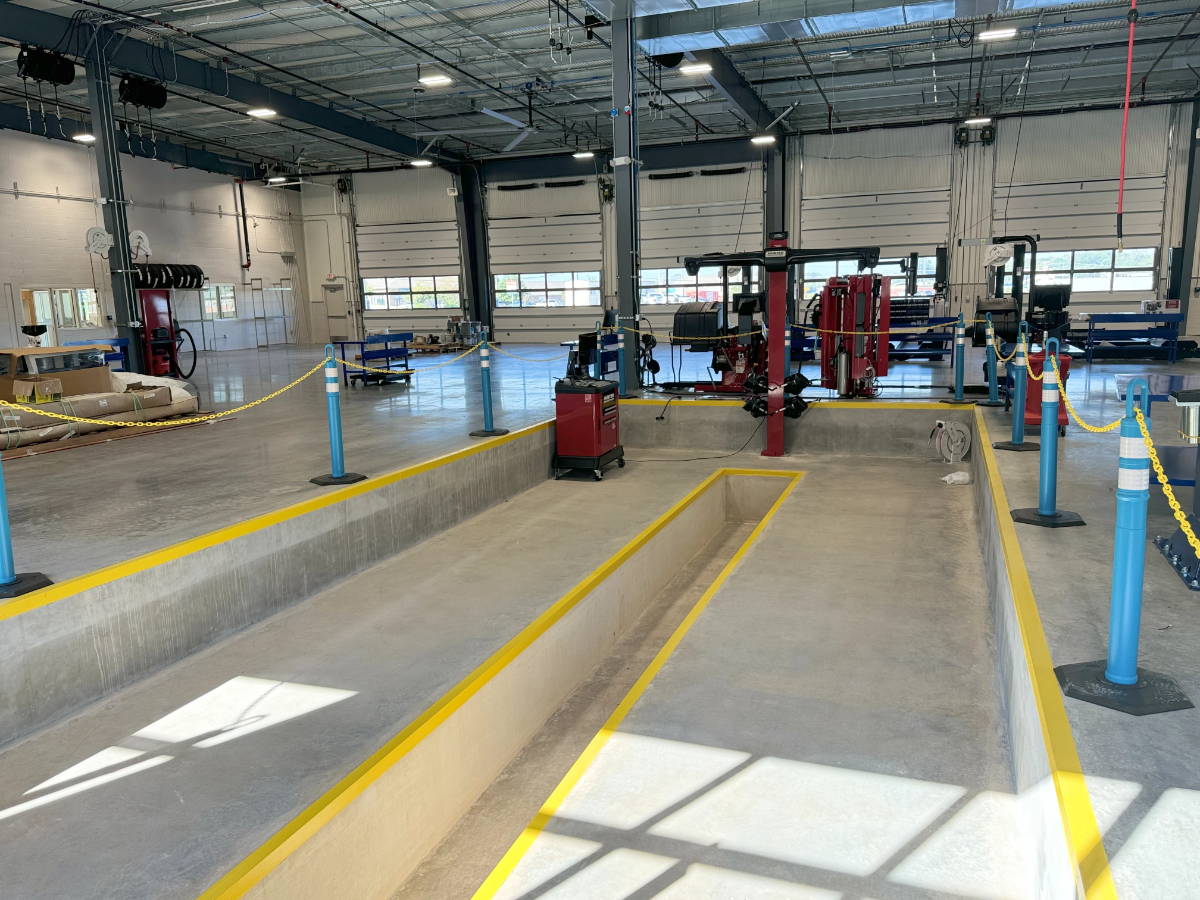
Our commercial bay in Clarksville. Bring a tape measure and the doorway dimension the van has to clear every day.
The fastest way to settle a roof height question is to stand in the van. We keep commercial inventory on the lot at 2655 Trenton Road and our commercial team will pull a tape measure with you.
Ford Pro Sales: (931) 538-3494
Ford Pro Service: (931) 538-7000
Address: 2655 Trenton Road, Clarksville, TN 37040
Browse commercial service vans, passenger wagons, or the full commercial inventory.
Spec the Right Roof the First Time
Our commercial team works with the upfitters directly. Tell us the trade and the route, and we will tell you which roof and wheelbase to order.
Jenkins and Wynne Ford Pro | 2655 Trenton Road, Clarksville, TN 37040 | Tennessee's first Ford Pro Elite Commercial Service Center