

How Clarksville HVAC and Plumbing Companies Run Leaner with the Ford Transit
The margin in a mechanical trade is not won on the invoice. It is won on the trips you did not have to make back to the shop, and on the twenty minutes a technician did not spend hunched over in a truck bed looking for a fitting. Here is where the Transit actually pays for itself in Montgomery County.
In This Article
- The Second Trip Is What Costs You
- Standing Up Inside the Van Is Not a Comfort Feature
- The Low Load Floor and the Hundred Lifts a Day
- Upfitting: Order the Roof Before You Order the Shelving
- Clarksville Routes, Industrial Park Contracts, and Base Work
- Which Transit Configuration Fits Your Trade
- Frequently Asked Questions
The Second Trip Is What Costs You
Ask any Clarksville plumbing or HVAC owner where the day goes and you will get the same answer. A technician arrives, opens the job, finds he is missing one part, and drives back. Across a four-truck operation that happens several times a week, and every occurrence is an hour of billable time turned into fuel and mileage.
A pickup makes that worse in a way that is easy to miss. A bed cannot be organized into fixed storage, so inventory lives in whatever toolboxes fit, and nobody can tell at a glance what is actually on the truck. A cargo van fixes the problem structurally. Every part has an address, and a technician restocks against empty slots rather than against memory.
That is the real case for the Transit in a mechanical trade. Not horsepower, not styling. It is that a van with 246.7 to 487.3 cubic feet of enclosed, organizable space carries the whole parts inventory a service call might need, and it keeps that inventory dry and locked overnight.
Standing Up Inside the Van Is Not a Comfort Feature
The High Roof Transit gives 81.5 inches of interior cargo height. That is 6 feet 9.5 inches, so a technician up to roughly 6 feet 5 inches works fully upright inside. The Medium Roof gives 72.0 inches, which suits a crew under 6 feet. The Low Roof gives 56.9 inches, which means kneeling.
This reads like a comfort spec and it is not. A technician who can stand inside the van preps and assembles there. Cutting and threading pipe, staging a condensate line, sorting fittings before walking into a customer's house, writing up the ticket out of the weather. All of that happens in the van instead of on a homeowner's driveway or a commercial rooftop, which is faster and looks considerably more professional to the customer paying the bill.
It also matters for retention. Bent-over work in a truck bed, in August in Tennessee, is how you lose good technicians to the shop down the road that bought vans.
Can a technician stand up in it?
Where the stand-up height earns its money
- Prepping and threading pipe on residential service calls in Sango and Rossview without setting up on the customer's driveway
- Staging a full changeout the night before so the truck leaves loaded and sequenced
- Writing up tickets and pulling parts out of summer heat and winter rain
- Rooftop unit work on commercial contracts, where staging happens at the van and not on the roof
The Low Load Floor and the Hundred Lifts a Day
The Transit's cargo floor sits low for a full-size van. That single design decision changes the physical cost of the job more than any other spec on the sheet.
A service technician loads and unloads dozens of times a day. Compressors, water heaters, sheet metal, tool bags, a recovery machine. Every one of those is a lift, and the height of the lift is set by the floor. A lower floor means less lifting into the van, an easier reach to the back of the load, and a shorter step for a person carrying something heavy in both hands. Over a year that is thousands of repetitions and it shows up as fewer strained backs and fewer lost days.
Width helps too. There are 54.8 inches between the rear wheel wells, so a 48-inch sheet of sheet metal or drywall lays flat on the floor rather than riding at an angle against the wall. Cargo floor length runs from about 126 inches on the shortest van to 172.2 inches on the Extended Length, so a 10-foot stick of pipe travels inside on the longer wheelbases instead of hanging out the back.
Back to topUpfitting: Order the Roof Before You Order the Shelving
This is the sequencing mistake that costs Clarksville trades operations real money. The roof height you order determines which upfit packages will physically fit, so it has to be decided first.
Transit-specific shelving, drawer units, pipe racks, partitions, and bin systems are built by established upfit partners including Ranger Design and Adrian Steel, and they mount to the van's factory attachment points rather than being drilled in on a guess. Because the Transit is one of the highest-volume commercial vans in North America, that catalogue is deep, which is a genuine advantage over less common platforms where you take whatever the one vendor offers.
The other thing to sequence early is payload. Maximum payload reaches 5,103 lbs on a properly equipped Transit 350 HD dual rear wheel Extended Length High Roof with the 3.5L EcoBoost V6 at the 11,000 lb GVWR rating. But a full shelving package, a partition, a ladder rack, and a stocked mechanical inventory take a serious bite out of that. Have the upfit weight subtracted before you settle on a GVWR class, not after the van is built and you discover you are over.
Clarksville Routes, Industrial Park Contracts, and Base Work
Montgomery County is not one service market, it is three, and they ask different things of a van.
Residential growth on the south and east side
Clarksville's residential build-out keeps pushing outward, and the service work follows it a few years later. These are short-hop routes with a lot of stops, which favours a van a technician can restock quickly and work out of between calls. Rear-wheel drive handles this fine in a normal Tennessee year.
Industrial Park and commercial mechanical contracts
The Clarksville Industrial Park runs to roughly 24 square miles and counts LG Chem, Hankook Tire, Google, Bridgestone and Amazon among its tenants. Facilities at that scale run mechanical contracts with response-time commitments, and a contractor bidding that work needs vans that show up looking like a professional operation and carrying enough inventory to close the call on the first visit. A High Roof with a full shelving package is the configuration that wins those bids.
Fort Campbell and the north end
Work tied to Fort Campbell and the corridor north toward Hopkinsville adds distance and, for some contracts, site access requirements. If your crews commit to same-day service through winter weather or run unpaved job-site access, Intelligent AWD is worth pricing. It adds roughly 4,200 dollars and most Clarksville fleets do not need it, so decide it on your actual route rather than on principle.
Route notes worth checking before you spec a High Roof
- A High Roof Transit stands 110.1 inches tall, about 9 feet 2 inches, so confirm your own shop bay opening before you order
- Covered parking and structured decks commonly post clearance under 8 feet, which a High Roof will not make
- If your contracts take crews onto Fort Campbell, confirm height limits for the specific gates and facilities in your scope
- US-41A and I-24 access from our Trenton Road location keeps most Montgomery County service territory inside a short drive for warranty and service work
Which Transit Configuration Fits Your Trade
A starting point, not a quote. Bring us your real route and load and we will price the specific build.
| Configuration | Interior Height | Best For | Trade-Off |
|---|---|---|---|
| Transit 250 or 350 High Roof, 148 in WB | 81.5 in | Full-service HVAC and plumbing where a technician works inside the van. The default recommendation for both trades. | Needs 110.1 in of overhead clearance everywhere it goes. |
| Transit 250 Medium Roof, 148 in WB | 72.0 in | Crews under 6 feet, or vans loaded and unloaded from outside rather than worked in. | Still 100.8 in tall, so it does not solve a garage-clearance problem either. |
| Transit 350 HD High Roof Extended Length | 81.5 in | Heaviest inventory loads, commercial changeout work, maximum payload and 487.3 cu ft of cargo volume. | Longest and heaviest to manoeuvre on tight residential stops. |
| Transit Low Roof | 56.9 in | Only when a hard height restriction makes the decision for you. | Nobody works inside it. Rear door opening drops to 49.5 in. |
Capability figures are maximums for a properly equipped vehicle and vary by wheelbase, body length, roof, drivetrain and equipment. See the Ford Transit specifications and confirm the build sheet for your configuration before ordering.
More detail on the dimensions behind this table is in our Ford Transit high roof height and interior dimensions guide.
Frequently Asked Questions
Is a Ford Transit better than a pickup for an HVAC or plumbing business?
For most Clarksville mechanical trades, yes. A pickup bed is open to weather and theft, and it cannot be organized into fixed parts storage. A Transit locks everything inside, keeps it dry, and lets a technician find a fitting in seconds instead of digging through a toolbox. The exception is a crew that hauls equipment too large or too dirty to go inside a van, where a Super Duty with a service body is the better answer.
Can a technician stand up inside a Ford Transit?
In a High Roof Transit, yes. Maximum interior cargo height is 81.5 inches, so an adult up to roughly 6 feet 5 inches works upright inside. The Medium Roof gives 72.0 inches, which suits someone under 6 feet. The Low Roof at 56.9 inches is a kneeling van and is not suitable for anyone assembling or prepping work inside the vehicle.
How much shelving can I fit in a Ford Transit?
Enough for a full mechanical parts inventory on a Medium or High Roof. Upfit partners such as Ranger Design and Adrian Steel build Transit-specific shelving, drawer units, pipe racks, and partitions that mount to the van's factory attachment points. The roof height you order determines which packages fit, so pick the roof before you order the shelving, not after.
What does shelving do to a Transit's payload?
It reduces it, sometimes by more than owners expect. A full shelving package, a partition, a ladder rack, and a stocked parts inventory can take a four-figure bite out of available payload. Maximum payload reaches 5,103 lbs on a properly equipped Transit 350 HD, but the number that matters is what is left after your upfit. Ask our commercial team to subtract the upfit weight before you settle on a GVWR class.
Do I need all-wheel drive for Clarksville service routes?
Most Montgomery County routes do not require it. Rear-wheel drive is standard and handles Clarksville weather in a normal year. Intelligent AWD is worth considering if your crews commit to same-day service through winter weather, run gravel or unpaved job-site access, or cover the higher ground north toward Fort Campbell and Hopkinsville. It adds roughly 4,200 dollars to the build.
What kind of fuel economy does a Ford Transit get?
The Transit is exempt from EPA fuel economy labeling because of its weight class, so there is no official EPA rating to quote. Real-world consumption varies widely with roof height, wheelbase, upfit weight, and how much of your route is stop-and-go. Compare vans on total operating cost with your actual route rather than on a headline mpg figure, and ask us to model it against your current fleet.
How fast can Jenkins and Wynne Ford Pro service a down van?
We are Tennessee's first Ford Pro Elite Commercial Service Center, which means dedicated commercial service lanes separate from the retail store and extended hours built around fleet schedules. Ford Pro Mobile Service can also handle qualifying work at your yard rather than ours. Call our Ford Pro service line at (931) 538-7000 to talk through coverage for your fleet size.
Can a plumbing or HVAC company write off a work van?
Section 179 of the tax code allows qualifying businesses to deduct the cost of qualifying work vehicles placed in service during the tax year, and commercial vans are frequently eligible. Eligibility, limits, and how the deduction applies depend entirely on your business and your tax situation. We can point you to the details, but talk to your own tax advisor before counting on a specific number.
Next steps: browse commercial service vans in stock, read about Ford Pro Elite Commercial Service, look at Ford Pro Telematics if you are tracking a multi-van fleet, or start a commercial financing conversation. If you are buying before year end, our Section 179 page covers the basics to take to your tax advisor.
Bring Us Your Route and Your Load
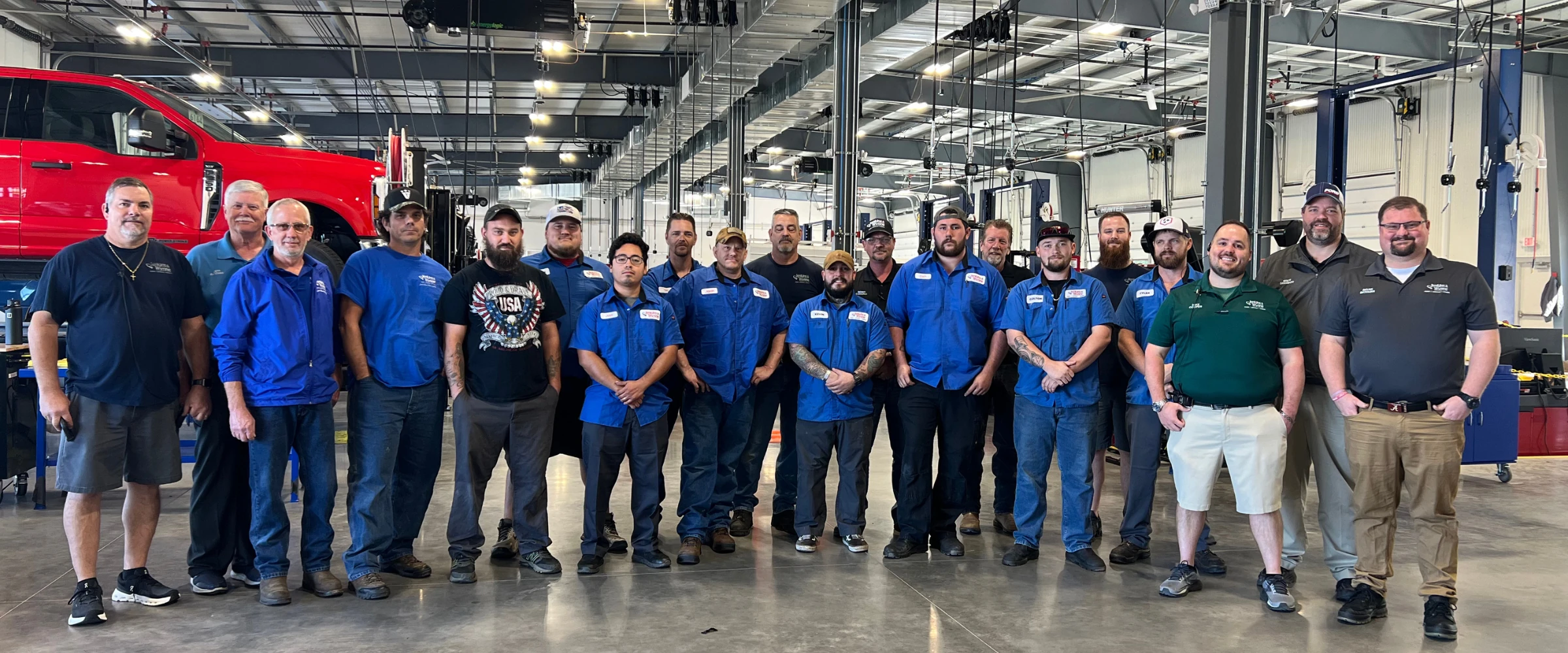
The Ford Pro Elite Commercial Service Center team on Trenton Road. Tennessee's first, and the reason a downed van does not sit in a general queue.
Tell our commercial team what your crews carry and where they go. We will spec the roof, the wheelbase, and the upfit around the actual work instead of a brochure.
Jenkins and Wynne Ford Pro | 2655 Trenton Road, Clarksville, TN 37040 | Tennessee's first Ford Pro Elite Commercial Service Center