

Which Ford Transit Configurations Have a Smart Alternator?
The short answer: every gas Ford Transit has one. Ford calls it Smart Regenerative Charging, and it runs on every Cargo Van, Passenger Van, Cutaway and Chassis Cab with either 3.5L V6. You cannot order it off. The all-electric E-Transit has no alternator at all.
Smart Alternator by Transit Configuration
The Ford Transit smart alternator is not a trim feature. It is how every gas Transit charges its battery. Ford's upfitter manual puts it plainly: "Alternator systems use Smart Regenerative Charging (SRC)." What does change by configuration is how much alternator you can order.
| Configuration | Standard Alternator | Dual Alternator (63C) | Smart Charging |
|---|---|---|---|
| Cargo Van, 3.5L EcoBoost V6 | 250 amp | Available | Yes |
| Cargo Van, 3.5L PFDi V6 | 250 amp | Not available | Yes |
| Passenger Van XL and XLT, either V6 | 250 amp | Not available | Yes |
| Cutaway, 3.5L EcoBoost V6 | 250 amp | Available | Yes |
| Chassis Cab, 3.5L EcoBoost V6 | 250 amp | Available | Yes |
| Cutaway and Chassis Cab, 3.5L PFDi V6 | 250 amp | Not available | Yes |
| E-Transit, all body styles | No alternator | Not available | No alternator |
Three things to take from the table. Smart charging is on every gas Transit. The dual alternator needs the EcoBoost and is not offered on the Passenger Van. And the E-Transit charges its 12-volt battery a different way entirely, from the high-voltage battery through a DC-to-DC converter.
Older vans are the exception. Ford's 2015 Transit upfitter manual shows a conventional charging system with no battery monitoring sensor. Smart Regenerative Charging appears in Ford's 2020 manual, which covers the current PFDi and EcoBoost engines.
Back to topWhat Smart Regenerative Charging Does
A Battery Monitoring Sensor at the negative battery terminal tells the van how charged the battery is. The system then moves alternator output up and down to save fuel. It charges harder when you coast or brake, when that energy costs almost no fuel. It backs off when the battery is full, and the battery carries the electrical load for a while.
That is great for fuel economy. It is less great for anything bolted on that expects a steady 14 volts.
Transit charging voltage by mode
Ford's own manual names the equipment that notices. Converters that need 13.5 to 14.9 volts, including "boost or supplemental battery charging," may not get it while smart charging has the voltage down near 12.2. A second battery on a basic charging relay is the classic example. It can sit undercharged all day while the van runs.
Back to topHow to Switch Smart Charging Off
You cannot remove it. Ford's manual says it is not possible to decommission smart charging because of homologation, vehicle tax and excise requirements. What Ford does provide is a switchable override called Third Party High Power mode.
- What it does: grounding one circuit switches the van from Smart Regenerative Charging to Conventional Charging, 13.5 to 14.9 volts. The same signal can also stop automatic engine idle shutdown and delay the Standard Battery Guard timer at engine off.
- Where it lives: pin 3 of the Vehicle Interface Connector at the driver's seat pedestal, or pin 24 of the High Specification Vehicle Interface Connector on vans that have it.
- How to wire it: through a switch or a controller that turns it on only while the equipment needs it. Ford says it must never be grounded permanently, because that invalidates the van's emissions certification.
Ford recommends the override for heavy loads. Its manual notes that an overloaded alternator shows voltage dropping below 12.8 volts and could be damaged, and says Third Party High Power mode must be used for engine-running applications fed from the battery stud.
Back to topAlternator and Battery Order Codes
If you are ordering a Transit for an upfit, these are the charging and electrical codes worth knowing from Ford's 2026 order guide.
| Code | What It Is | Notes |
|---|---|---|
| Standard | 250 amp alternator, single 70 Ah AGM battery | Both gas engines, every body style. |
| 63C | Dual Alternator, 250 amps each | EcoBoost only. Cargo Van, Cutaway and Chassis Cab. Includes the 87E fuse panel, and Pro Power Onboard 400 W on most Cargo, Cutaway and Chassis Cab builds. |
| 63E | Dual AGM Batteries, 70 Ah each | Available on every body style. Adds the 175 amp switched Customer Connection Point. |
| 87E | Auxiliary Fuse Panel with High Spec Interface Connector | Includes 63E and the 53K Modified Vehicle Wiring System. |
| 67C | Upfitter Package | High Capacity Upfitter Switches, large center console and the 87E fuse panel. Not available on E-Transit. |
| 55A | Vehicle Integration System 2.0 | Ford recommends it for any van running aftermarket upfit equipment. Standard on Cutaway and Chassis Cab. |
| 90E | Pro Power Onboard, 2.4 kW | E-Transit only. |
The dual alternator is the one to spec for heavy electrical work: an inverter running power tools, a mobile workshop, refrigeration or a big lighting package. Keep in mind that it still runs smart charging. Two alternators mean more capacity, not a fixed voltage.
Back to topWiring an Upfit Around a Smart Alternator
Ford's upfitter manual sets out the rules for adding batteries and heavy loads to a Transit. Here are the ones a Clarksville electrician, HVAC contractor or mobile service business runs into first.
- Charge a second battery with a DC-DC charger. Ford says to use a charger suited to the battery you add, and names a DC-DC charger as the example. Connect it directly to the added battery.
- Ground to the body, not the battery. Grounding a high load to the negative battery terminal bypasses the Battery Monitoring Sensor, and the van loses track of its own battery.
- Isolate added batteries at key off. Use the 175 amp Customer Connection Point on a twin-battery van, or a relay or battery guard driven by the load-shedding signal.
- Stay inside the current limits. Up to 60 amps from the standard connection point, and up to 175 amps from the second one on twin-battery vans.
- Keep key-off drain low. Ford says total sleep current should not exceed 100 milliamps, or the sensor cannot read battery charge accurately.
- No voltage boosters. Ford does not permit devices that boost alternator output.
- Tell the van about new batteries. When batteries are changed, Ford requires a dealer service tool to reprogram the battery configuration. A wrong setting upsets smart charging.
Our Ford Pro Elite Commercial Service Center has that service tool, and it keeps extended hours for fleets running around Fort Campbell and Montgomery County. If you are building a van from scratch, start with our Commercial Vehicle Center team, and ask about commercial financing that can include the upfit.
Sources
- Ford Transit and E-Transit Body and Equipment Mounting Manual, North America (PDF)
- Ford 2026 Transit order guide (PDF)
- Ford Pro upfitter publications
Frequently Asked Questions
Does the Ford Transit have a smart alternator?
Yes, every gas Ford Transit does. Ford's Smart Regenerative Charging varies alternator output based on a battery monitoring sensor, on every Cargo Van, Passenger Van, Cutaway and Chassis Cab with the 3.5L PFDi or 3.5L EcoBoost V6. The E-Transit has no alternator.
Can I turn off smart charging on a Transit?
Not permanently. Ford says smart charging cannot be decommissioned. Ford's Third Party High Power mode switches the van to Conventional Charging while it is active, through a switched ground on the Vehicle Interface Connector. Ford says it must never be grounded permanently.
What voltage does the Transit alternator put out?
Ford lists approximate ranges of 12.2 to 14.9 volts in normal smart charging and 13.5 to 14.9 volts in Conventional Charging, measured at the jump-start post. A refresh mode after the van sits more than 30 days may reach 15.2 volts.
Which Transit can get dual alternators?
The Dual Alternator option, code 63C, adds a second 250 amp alternator. It requires the 3.5L EcoBoost V6 and is offered on the Cargo Van, Cutaway and Chassis Cab. It is not available on the Passenger Van, with the 3.5L PFDi V6 or on the E-Transit.
Do I need a DC-DC charger for a second battery in my Transit?
Ford's upfitter manual tells you to use a charger suited to the battery you add and names a DC-DC charger as the example. Smart charging can drop system voltage to about 12.2 volts, which a basic charging relay may not use well. Connect the charger directly to the added battery.
Where should I ground an inverter or a second battery in a Transit?
To the vehicle body, not the negative battery terminal. Ford warns that a ground at the battery negative bypasses the Battery Monitoring Sensor, which the smart charging system depends on. Ford gives the same rule for the ground side of any added charging system.
How does the E-Transit charge its 12-volt battery?
From its high-voltage battery through a DC-to-DC converter. Ford says it will top up the 12-volt battery this way even with the van switched off when the charge runs low. The E-Transit also offers Pro Power Onboard at 2.4 kW.
Can your Clarksville service center set up a Transit after an upfit?
Yes. Ford requires a dealer service tool to reprogram battery configuration when batteries change, and our Ford Pro Elite Commercial Service Center on Trenton Road has it. Call Ford Pro Service at (931) 538-7000 or our sales team at (931) 538-3494.
Charging voltages are Ford's published approximate figures and vary with battery state, temperature and load. Electrical upfits must follow the current Ford Transit Body and Equipment Mounting Manual for the vehicle's model year. Option availability varies by body style, engine and package. Confirm the build with our Ford Pro team before ordering. Learn more about the E-Transit.
Spec the Electrical Before the Van Arrives
Tell us what the van has to power. Our Ford Pro team will match the alternator, battery and upfitter codes to the job before you order, so the upfit goes in clean.
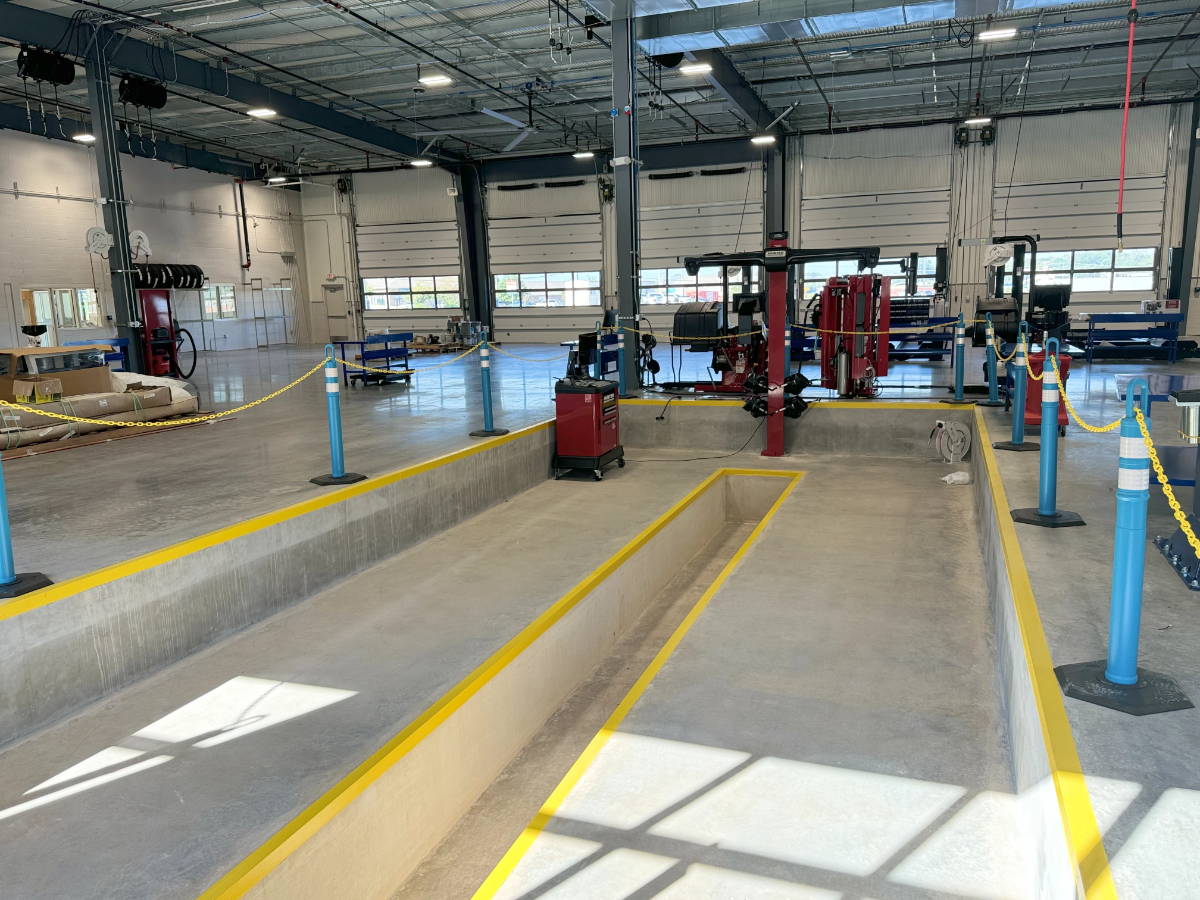
The drive lane at our Elite Commercial Service Center on Trenton Road.
Ford Pro Sales: (931) 538-3494
Ford Pro Service: (931) 538-7000
Address: 2655 Trenton Road, Clarksville, TN 37040
Build a Transit That Powers the Whole Job
Cargo vans, cutaways and chassis cabs, with the electrical specced for your upfit before it leaves our lot.
Jenkins and Wynne Ford Pro | 2655 Trenton Road, Clarksville, TN 37040 | Tennessee's first Ford Pro Elite Commercial Service Center