

Ford F-350 Towing Capacity Chart: Diesel, Gas, and Payload by Configuration
The short answer: a properly equipped F-350 tows up to 28,000 lbs conventional and 38,000 lbs gooseneck, with up to 8,000 lbs of maximum available payload. Almost no F-350 on the road is rated for those numbers, and this page explains why.
F-350 Towing Capacity by Engine
Engine choice sets the ceiling. Everything else on the order sheet moves you down from it. The 2026 F-350 offers four engines, and the gap between the bottom and the top of the range is roughly 10,000 lbs of conventional towing.
| Engine | Output | Max Conventional Tow | Best Suited To |
|---|---|---|---|
| 6.8L V8 Gas (standard) |
405 hp / 445 lb-ft | Up to about 18,000 lbs | Budget fleet spec. Fine for equipment trailers and lighter job-site work, not for a heavy gooseneck. |
| 7.3L V8 Gas ("Godzilla") |
430 hp / 485 lb-ft | Up to about 22,000 lbs | The best gas towing option, and the engine behind the highest payload ratings because it weighs less than a diesel. |
| 6.7L Power Stroke Diesel (standard output) |
475 hp / 1,050 lb-ft | Up to about 25,000 lbs | The value diesel. Out-tows both gas engines by a wide margin and covers most commercial towing. |
| 6.7L Power Stroke Diesel (high output) |
500 hp / 1,200 lb-ft | Up to 28,000 lbs | The only engine that reaches the headline maximums, including 38,000 lbs on a gooseneck with dual rear wheels. |
F-350 maximum towing by engine
Single Rear Wheel or Dual Rear Wheel
After engine, this is the biggest lever on the chart. SRW means one tire per side. DRW, the four-tire setup people call a dually, spreads load across far more tire contact patch.
That extra contact patch is what unlocks the top of the range. The 38,000 lb gooseneck rating is a dual rear wheel figure and is not available any other way. Maximum payload also climbs substantially with DRW, because the rear axle can legally carry more.
The cost is practical rather than mechanical. A dually is wider, which matters on tight residential job sites, in older downtown Clarksville alleys, and in any parking structure. Tires cost more and there are six of them. If your heaviest regular tow is an equipment trailer well inside the SRW range, a dually is money and hassle you do not need.
Payload Is the Number That Catches People Out
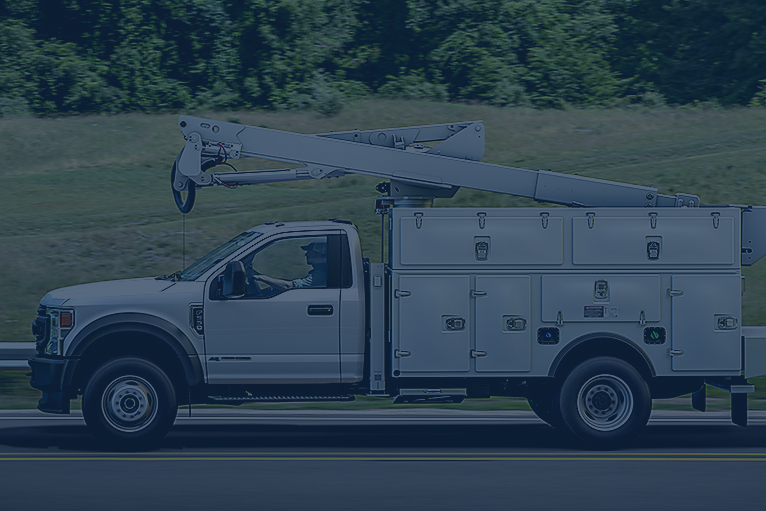
An enclosed service body. Everything bolted to the frame comes straight off the payload number before a single tool is loaded.
Maximum available payload on an F-350 is up to 8,000 lbs, the highest in the Super Duty pickup lineup. Almost nobody gets it, and the reason is counterintuitive.
That 8,000 lb figure comes from a gas dual rear wheel configuration. A diesel engine weighs several hundred pounds more than a gas V8, and every one of those pounds comes straight out of payload, because payload is simply GVWR minus what the truck already weighs. Add four-wheel drive, a crew cab, a long bed, and the truck is heavier again before you load anything.
Then comes the upfit. A service body, a crane, a compressor, a fuel tank, a toolbox full of stock. On a working truck that package can consume a large share of what is left. And trailer tongue weight counts as payload too, which is the part that surprises people: hitching a heavy gooseneck puts a meaningful load on the rear axle before a single tool goes in the bed.
How to Find the Real Rating for Your Truck
Every chart online, this one included, describes a range. Here is how to get the number that actually applies to a specific vehicle.
- Start at the door jamb sticker. The driver's door pillar carries GVWR and the axle weight ratings for that exact truck as built. This is the legally meaningful document, not a brochure.
- Get the GCWR. Gross Combined Weight Rating is the maximum for truck and trailer together, including fuel, passengers, cargo and tongue weight. Tow rating is derived from it by subtracting what the truck weighs. This is why loading the truck lowers what it can pull.
- Match the axle ratio. Two otherwise identical F-350s with different rear axle ratios can carry meaningfully different tow ratings. The ratio is on the door jamb or the build sheet.
- Look up the exact build in the Ford Towing Guide. Ford publishes a towing guide per model year with ratings broken out by cab, bed, engine, drive type and axle. That document is the authority.
- Weigh the rig loaded. A certified scale with the truck loaded as it actually works, trailer attached, is the only way to know where you really sit. Fleet operators who do this once are usually surprised.
We will do this with you. Bring the VIN or the build sheet to our Ford Pro team and we will pull the ratings for that specific truck rather than quoting a range. Reference material is on the Ford Super Duty specifications page and the Ford towing and hauling guide.
Back to topF-250 or F-350 for a Clarksville Fleet
Most Montgomery County crews asking this question are somewhere between the two, so here is the honest split.
The F-250 covers a lot of commercial work. Towing equipment trailers, skid steers and mini excavators around Clarksville job sites, running material to sites along the US-41A corridor, general contractor duty. It is single rear wheel only, which keeps it easier to park and cheaper on tires.
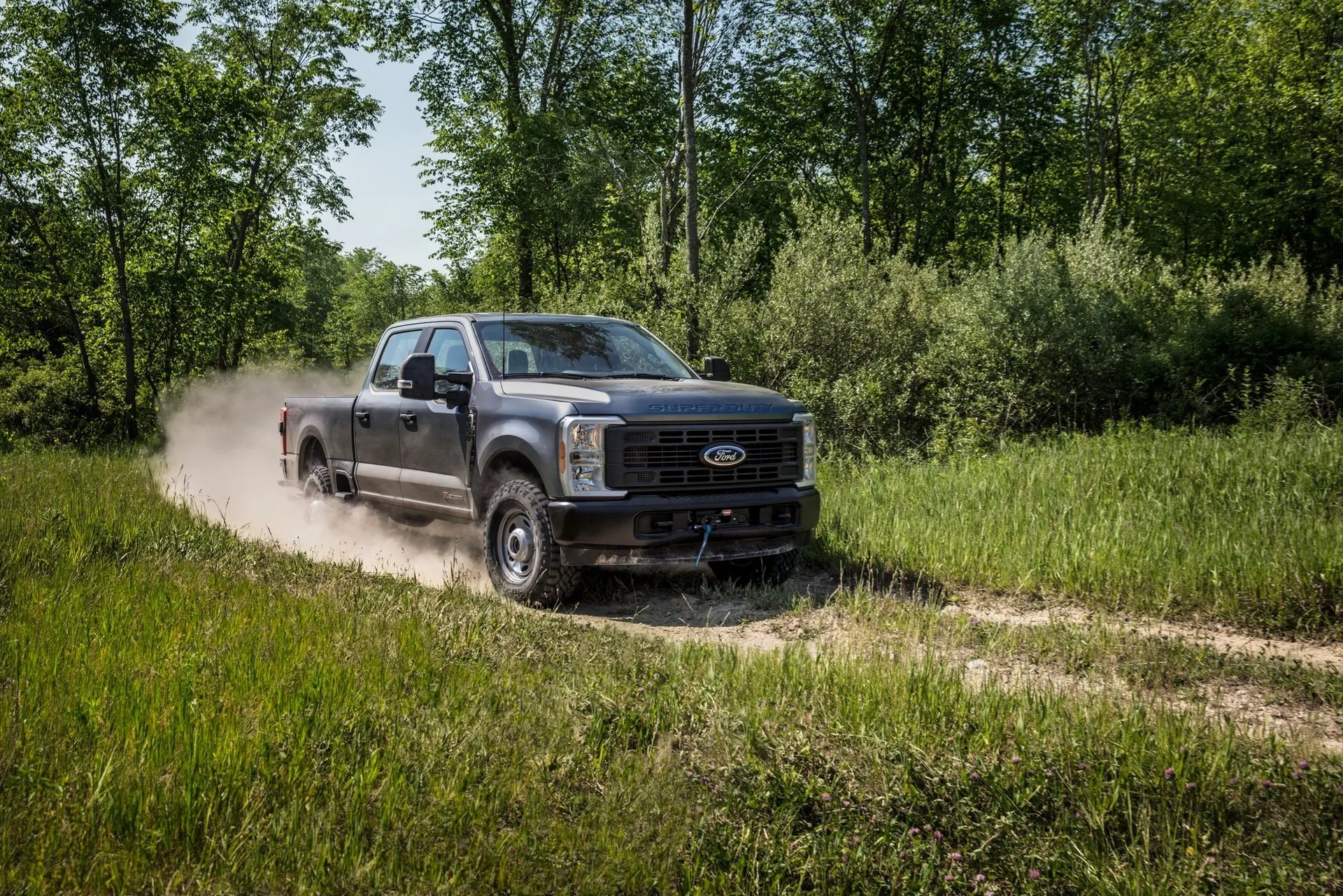
A Super Duty F-250 XL, the work-spec configuration. The F-350 shares this body and cab; what changes is the chassis, the rear axle and the availability of dual rear wheels.
Step up to the F-350 when one of three things is true: you need dual rear wheel availability, you are mounting a service body or crane that eats payload, or your heaviest tow is a gooseneck the 250 cannot legally handle. Those are the reasons. Buying a 350 because it sounds tougher is how fleets end up paying for capability that never gets used.
If the load is bigger still, the F-450 and the F-550 chassis cab exist above this, and we sell both. Our commercial team would rather put you in the right truck than the expensive one, so bring us the heaviest thing you actually pull.
Back to topFrequently Asked Questions
How much can a Ford F-350 tow?
A properly equipped Ford F-350 Super Duty tows up to 28,000 lbs with a conventional hitch and up to 38,000 lbs with a gooseneck or fifth-wheel hitch. Both of those are maximums for one specific build, not a rating every F-350 carries. A gas single rear wheel truck starts closer to 18,000 lbs, so the spread across the lineup is roughly 20,000 lbs depending on how the truck is configured.
What is the maximum payload of a Ford F-350?
Maximum available payload is up to 8,000 lbs on a properly equipped F-350, which is the highest in the Super Duty pickup lineup. That figure comes from a dual rear wheel gas configuration, because the lighter gas engine leaves more of the GVWR available for cargo. Add a diesel, four-wheel drive, a crew cab and a heavy upfit and real payload drops well below the headline.
Which F-350 engine tows the most?
The 6.7L high-output Power Stroke diesel V8, rated at 500 hp and 1,200 lb-ft of torque. It carries the highest ratings in the lineup and is the only engine that reaches the 28,000 lb conventional and 38,000 lb gooseneck maximums. The standard-output 6.7L Power Stroke at 475 hp and 1,050 lb-ft is the value choice and still out-tows both gas engines by a wide margin.
What is the difference between SRW and DRW on an F-350?
SRW is single rear wheel, one tire per side. DRW is dual rear wheel, the four-tire setup often called a dually. DRW spreads load across more tire contact patch, which raises both payload and the heavy gooseneck and fifth-wheel ratings substantially. The trade is width, tire cost and how the truck behaves in tight job-site and parking situations. If your heaviest tow is a gooseneck near the top of the range, DRW is not optional.
Why is my F-350 rated lower than the number in the ads?
Because advertised maximums describe one optimally configured truck. Your rating is set by the combination of engine, cab, bed length, four-wheel drive, axle ratio, rear wheel setup and installed equipment, and every one of those either adds weight or changes the GCWR. A crew cab 4x4 with a long bed and a heavy upfit can sit many thousands of pounds below the headline. The rating for your truck is on the door jamb sticker and in the Ford Towing Guide for that exact build.
Do I need a gooseneck or fifth-wheel hitch to reach the highest ratings?
Yes. The 38,000 lb figure is a gooseneck or fifth-wheel rating and cannot be reached with a conventional bumper-pull hitch. A gooseneck puts the trailer's pin weight over the rear axle instead of behind it, which is a fundamentally more stable way to carry heavy tongue load. Conventional towing tops out at 28,000 lbs, and that still requires the high-output diesel and the right axle and hitch equipment.
What is GCWR and why does it matter more than tow rating?
GCWR is Gross Combined Weight Rating, the maximum weight of the truck and the trailer together including fuel, passengers, cargo and tongue weight. Tow rating is derived from it by subtracting the truck's own weight. That is why adding passengers, tools and a bed full of material lowers what you can legally pull. Fleet operators who weigh their loaded rigs are often surprised at how little headroom is left, which is the whole reason to check GCWR rather than the tow number alone.
Is the F-350 or the F-250 the right truck for my Clarksville fleet?
The F-250 is the lighter-duty answer and suits crews towing equipment trailers and skid steers around Montgomery County. Step to the F-350 when you need dual rear wheel availability, higher payload for a service body or crane, or a gooseneck rating a 250 cannot reach. Bring us your heaviest real load and we will tell you honestly which one you need rather than selling you up a class. Call our Ford Pro team at (931) 538-3494.
All towing and payload figures on this page are maximums for a properly equipped vehicle and vary by cab, bed length, engine, drivetrain, axle ratio, rear wheel configuration and installed equipment. Super Duty trucks exceed 8,500 lbs GVWR and are not EPA-rated for fuel economy. Confirm ratings for a specific configuration against the Ford Towing Guide and the vehicle's door jamb sticker before towing.
Bring Us the Load, Not the Spec Sheet
Tell our Ford Pro team the heaviest thing you actually pull and how the truck gets used. We will pull the real ratings for the configurations that fit and tell you which class you need.
Ford Pro Sales: (931) 538-3494
Ford Pro Service: (931) 538-7000
Address: 2655 Trenton Road, Clarksville, TN 37040
Shop F-350 Super Duty, F-250 Super Duty, or the full commercial inventory. Heavier work starts at the Ford chassis cab.
Get the Rating for Your Actual Truck
We will look up the exact towing and payload ratings for a VIN or a build sheet, and tell you what is left after your upfit.
Jenkins and Wynne Ford Pro | 2655 Trenton Road, Clarksville, TN 37040 | Tennessee's first Ford Pro Elite Commercial Service Center